
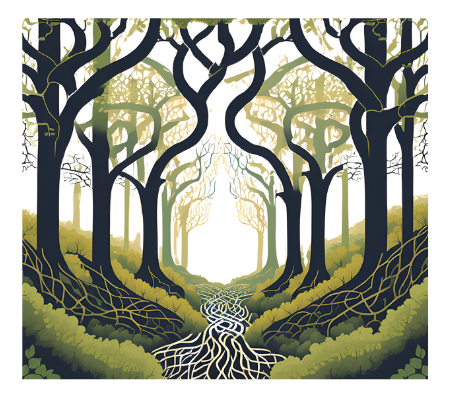
When a pine seedling struggles with drought, it triggers responses that cascade through multiple levels of the forest network.
Local networks. Nearby trees connected through shared fungal partners redirect water and nutrients to the struggling seedling. This is the forest’s intimate neighborhood response – direct help between close partners.
Forest-wide networks. These local exchanges send ripples through longer-distance connections that span the entire forest stand. Mature trees further away begin adjusting their own water conservation, preparing for the broader drought conditions that seem to be coming.
Meta-networks. At the largest scale, this information travels through ‘meta-networks’ – connections that span across forest patches, hillsides, and entire watersheds. Trees in distant forest stands begin, preparing their root systems for potential drought stress and adjusting their water storage strategies based on early warning signals from miles away.
This nested organization allows the forest to solve problems that no single scale could handle alone. Local networks provide immediate, precise responses. Forest-wide networks coordinate broader strategies. Meta-networks share information about regional patterns and long-term changes.
A single seedling’s struggle becomes part of the forest’s collective intelligence – information that helps the entire system learn, adapt, and become more resilient.
Networks within networks within networks, each contributing to the forest’s ability to thrive across every scale of challenge.